Skip to main menu Skip to main content Skip to footer
Phone Icon
xxx-xxx-xxxx
Calendar Icon
Request Appointment
Checklist Icon
LASIK Self-Test
Checklist Icon
Cataract Self-Test
Phone Pay Icon
Pay Bill Online

General Ophthalmology

There’s nothing more important than being able to see the world around you. Your eyes are how you see. That’s why eye exams are a crucial part of your wellness routine.

Doss Eye is here for all your eye care needs, whether an eye exam or an eye procedure.

What to Expect at An Eye Exam

Eye exams and checking your eyes are vital to staying healthy, like seeing your dentist or getting physicals from your doctor.

At an eye exam, your eye doctor will examine how healthy your eyes are and how they function.

Here are some of the tests they may perform:
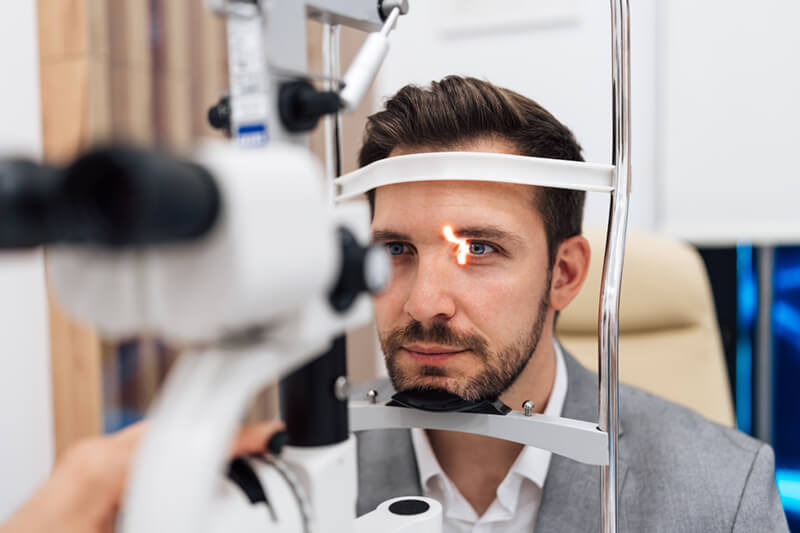
Person having an eye exam

Visual acuity is a test that checks how clearly you can see. Your ophthalmologist will have you read letters or look at pictures on a chart 20 feet away. 

Refraction is a test that checks if you’re nearsighted or farsighted. If you are, it will help find the precise prescription for glasses or contact lenses. 

You’ll look into an instrument called a phoropter. Your eye doctor will have you look at different lenses and ask if one or two look clearer. 

With this information, they can determine the best prescription for you.

Visual field is a test that checks your peripheral vision, meaning your side vision. You will focus on a point and then click a button once you see flashes of light around you. Your eye doctor may also move their finger from side to side and ask you to follow it by only moving your eyes, not your head.

Your eye doctor may check if you’re color blind and have difficulty telling different colors apart, like green and red. To do this, they will show you colored dots in patterns.

Your ophthalmologist will then ask you to identify numbers in the patterns.

Ophthalmoscopy is a test that allows your eye doctor to see the back of your eye. An ophthalmoscope is an instrument with a light and several small lenses that your eye doctor can look through to examine your eye. 

Performing this test helps them see how healthy other structures of your eye are that are not visible because of where they are located, like the retina, optic nerve, blood vessels, and choroid.

A slit-lamp exam has you place your chin on a rest and look into an instrument called a slit-lamp. The slit lamp helps magnify the front of your eye to see into your eye and see through the layers of your eyes. 

This exam helps your eye doctor see the inside of your eye, like the iris, pupil, and lens. You’ll likely need to have your eyes dilated if you undergo a slit-lamp exam during your eye exam. If your eyes are dilated, you can’t drive after your eye exam, so make sure you have a ride arranged to pick you up after your appointment.

Tonometry is a test that measures the pressure inside your eye. The pressure inside your eye is called intraocular pressure (IOP). If you have increased pressure in your eye, this is a risk factor for developing glaucoma.

Tonometry can be performed in a few ways. Your eye doctor may use a puff of air to flatten your cornea and measure the pressure inside your eye. Another way of measuring the pressure in your eye is applanation tonometry.

Your eye doctor will use a small probe to flatten your cornea and then a slit lamp to examine your eye. Finally, the third kind is your ophthalmologist who uses an electronic device to measure your intraocular pressure. 

They will place a small instrument directly on your cornea before reading the test results on a computer screen.

Why Eye Exams Are Necessary

Even for patients who don’t need to wear glasses and contact lenses and don’t have refractive errors, eye exams are still important and necessary. Eye exams are your best and only defense against eye conditions that can steal your sight. Other reasons include:

Visual Changes

Scheduling eye exams regularly with your eye doctor will ensure that if your eyes change over time, you’ll always have an updated prescription. Minor vision problems often start in childhood and, when left untreated, can lead to trouble in school with focusing, inability to see the board, or children feeling like they are being left behind.

Eye Exams Help Find Signs of Eye Conditions and Other Conditions

Having eye exams can help save your life. Not only can your eye doctor help find signs of eye conditions like glaucoma that can steal your sight, but they can do more.

Your eye doctor may also be the first to find signs of health conditions like diabetes, cancer, high blood pressure, and more. They may be the first to diagnose you, and if diagnosed early, this leads to earlier treatment.

Many Eye Conditions Don’t Have Symptoms

Eye conditions like glaucoma, cataracts, and macular degeneration may cause vision loss with little to no warning. Eye exams are one of the only ways to diagnose these eye conditions.

In the case of glaucoma, early detection is crucial, as most patients don’t realize they have the eye condition until they’ve already experienced permanent and irreversible vision loss.

Are you ready to make your eyes a priority?

Take the first steps by scheduling an appointment at Doss Eye in Los Angeles, CA, now!

Schedule Your Comprehensive Eye Exam Today

Take the first step towards clear vision and optimal eye health. Book your comprehensive eye exam now to experience the exceptional care of Doss Eye Medical Group.